Use cases
How each team uses Alikely, with one example each: the object, the template, the fields and what the card shows.
The same card works for each team; what changes is the object and the profile. Each example below starts from one of the profile editor's templates. The records in the examples are made up.
Alikely compares records already in your HubSpot account. For the other ways to find similar records, such as lookalike databases and HubSpot's own features, see how to find similar records in HubSpot.
Sales development: similar companies
On a prospect's company record, the card lists the customers that look most like it — your lookalike customers, found in your own CRM, and a relevant name to bring up on the call.
Object: companies. Template: Similar customers — only companies whose lifecycle stage is Customer.
A prospect compared with one customer
| Field | Level | This company → match | Result | Points |
|---|---|---|---|---|
| Industry | Very important | Logistics → Logistics | Match | 4 of 4 |
| Number of Employees | Very important | 300 → 340 | Match | 3.3 of 4 |
| Country/Region | Nice to have | Germany → Deutschland | Match | 1 of 1 |
Total 8.3 of 9 = 92%
This customer comes out at 92%: the same industry, a similar size, and “Deutschland” is the same country as “Germany”.
Account executives: won deals as references
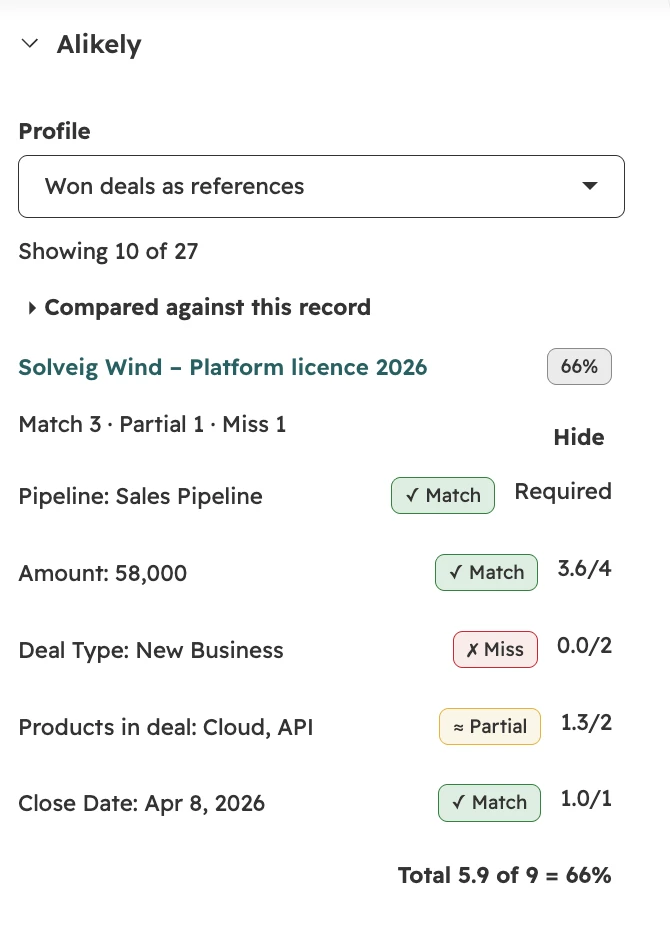
On an open deal, the card lists the won deals that look most like it — similar deals, and the reference customers behind them.
Object: deals. Template: Won deals as references — only closed won deals in the same pipeline.
An open deal compared with one won deal
| Field | Level | This deal → match | Result | Points |
|---|---|---|---|---|
| Pipeline | Required | Sales Pipeline → Sales Pipeline | Match | Required |
| Amount | Very important | 25,000 → 22,000 | Match | 3.3 of 4 |
| Deal type | Important | New Business → New Business | Match | 2 of 2 |
| Close date | Nice to have | Nov 30, 2026 → Jul 14, 2026 | Match | 1 of 1 |
Total 6.3 of 7 = 90%
This won deal comes out at 90%: the same pipeline and deal type, an amount close enough to be a match, and a close date within the template's 180 days.
Account executives: learn from colleagues
On an open deal, the card lists similar deals owned by someone else — so you can ask the colleague who has worked a deal like yours.
Object: deals. Template: Similar deals by other owners — the deal owner is a Must differ rule.
An open deal compared with a colleague's deal
| Field | Level | This deal → match | Result | Points |
|---|---|---|---|---|
| Deal owner | Must differ | Erik Lind → Maria Holm | Different | Must differ |
| Pipeline | Required | Sales Pipeline → Sales Pipeline | Match | Required |
| Amount | Very important | 30,000 → 33,000 | Match | 3.4 of 4 |
| Deal type | Important | New Business → New Business | Match | 2 of 2 |
| Close date | Nice to have | Dec 15, 2026 → Oct 2, 2026 | Match | 1 of 1 |
Match 4 · Different 1
Total 6.4 of 7 = 91%
This deal comes out at 91%: another owner, the same pipeline and deal type, a similar amount, and a close date within the template's 180 days.
Marketing: case studies and win stories
Which customers fit the case study or the win story you are planning? Start from the same template and add a filter on a property of your own — for example a checkbox that marks customers who agreed to be a reference — so only those are listed.
Object: companies. Template: Similar customers, with one filter added.
A customer compared with another customer
| Field | Level | This company → match | Result | Points |
|---|---|---|---|---|
| Industry | Very important | Medical Devices → Medical Devices | Match | 4 of 4 |
| Number of Employees | Very important | 80 → 130 | Partial | 1.2 of 4 |
| Country/Region | Nice to have | Norway → Norge | Match | 1 of 1 |
Total 6.2 of 9 = 69%
This customer comes out at 69%: the same industry and country, but a size between 1.23 and 2 times larger, so the size gives only part of its points.
Onboarding: delivered projects
On a new project, the card lists the completed projects most like it — to learn from before you start.
Object: projects. Template: Delivered projects — only completed projects.
A new project compared with one delivered project
| Field | Level | This project → match | Result | Points |
|---|---|---|---|---|
| Type | Important | Implementation → Implementation | Match | 2 of 2 |
| Target due date | Nice to have | Dec 1, 2026 → Jun 30, 2026 | Miss | 0 of 1 |
Total 2.0 of 3 = 67%
This project comes out at 67%: the same type, but a target date more than 90 days away.
Support: similar tickets
On a ticket, the card lists the earlier tickets most like it, each one click away.
Object: tickets. Template: Similar tickets.
A ticket compared with one earlier ticket
| Field | Level | This ticket → match | Result | Points |
|---|---|---|---|---|
| Pipeline | Required | Support Pipeline → Support Pipeline | Match | Required |
| Category | Very important | Product issue → Product issue | Match | 4 of 4 |
| Priority | Important | High → Medium | Miss | 0 of 2 |
| Source | Nice to have | Email → Email | Match | 1 of 1 |
Total 5.0 of 7 = 71%
This ticket comes out at 71%: the same pipeline, category and source, a different priority.
Support: the same issue in another stage
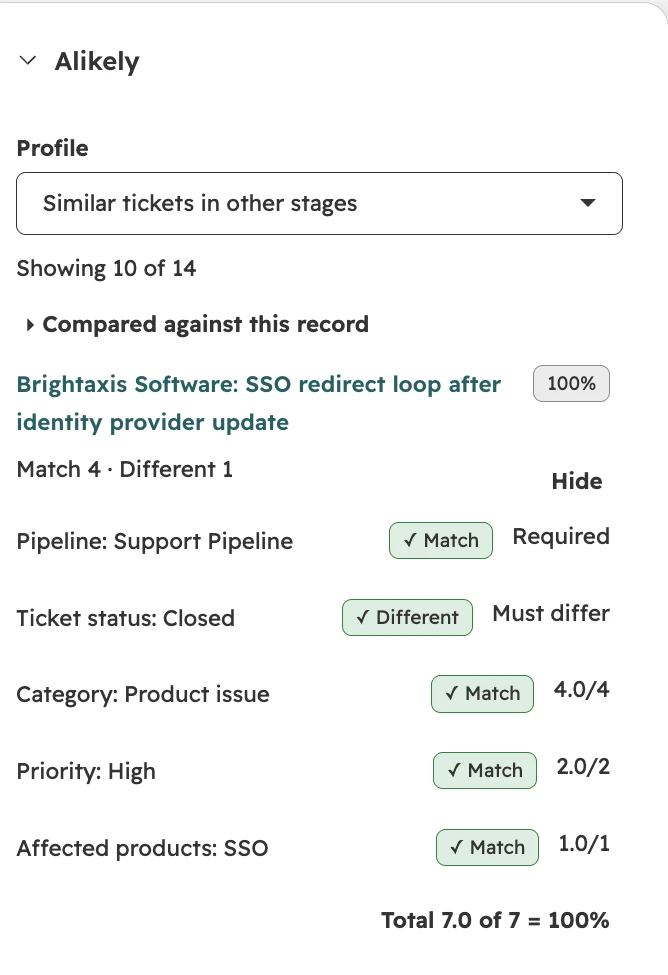
On a ticket, the card lists earlier tickets like this one that are in a different stage — for example one that is already closed.
Object: tickets. Template: Similar tickets in other stages — the ticket's stage is a Must differ rule.
A ticket compared with one in another stage
| Field | Level | This ticket → match | Result | Points |
|---|---|---|---|---|
| Pipeline | Required | Support Pipeline → Support Pipeline | Match | Required |
| Ticket status | Must differ | Waiting on contact → Closed | Different | Must differ |
| Category | Very important | Product issue → Product issue | Match | 4 of 4 |
| Priority | Important | High → High | Match | 2 of 2 |
Match 3 · Different 1
Total 6.0 of 6 = 100%
This ticket comes out at 100%: the same pipeline, category and priority, in another stage.
Any object works the same way, custom objects included, with the properties that describe your business. How the points are counted: How scoring works. How to set it up: the setup guide.